




Johnathan Millantz
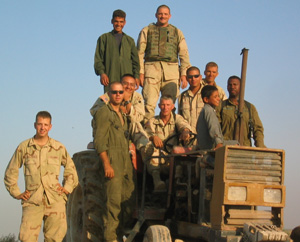
Johnathan Millantz (on left) in Iraq.
Photo courtesy Tony Sandoval
In the course of researching the radio documentary and my book about the legacy of US detainee abuse, None of Us Were Like This Before, I talked with many members of Adam Gray's unit. One soldier I got to know well was Jonathan Millantz. Millantz spoke many times with me and producer Michael Montgomery between 2006 and 2009. Eventually he told us some dark and disturbing stories about what his unit had done in Iraq. He was tortured with guilt for the part he had played in abusing Iraqi prisoners.
Before he joined the military, Millantz had been working what he called "Joe jobs," like pizza delivery, in his hometown of Greensburg, Pennsylvania. But when terrorists struck the United States on September 11, 2001, Millantz was filled with patriotic fervor and anger. Six months later, he joined the U.S. Army.
He signed up to be trained as a health care specialist. He hoped to apply his training in a clinical setting, but soon learned the Army had designated him to be a combat medic. A year later, Millantz was deployed to Iraq.
In Iraq, he used his medical skills to help fellow soldiers. But he was also assigned to check on Iraqis who'd been taken prisoner and held in a makeshift detention center. Millantz said what he saw there changed him forever. Those experiences transformed him into an anti-war activist.
Millantz was assigned to the 4th Infantry Division, and arrived in Iraq in April 2003 during the U.S. military's "shock and awe" bombing campaign.
"When I got into Iraq, what I saw was a country desperate for help and desperate for food, water and necessities to live," remembered Millantz. In time, he "arrived in Baghdad - to a city blown apart, bodies laying everywhere, and just a total mess."
But while Millantz saw some parts of the country laid to waste, he saw other areas where Iraqis happily greeted him and his fellow troops. The soldiers helped broken communities and worked cooperatively with locals.
"When we first arrived we were handing out water, candy to kids…and it was all right for the first few days," he said. "Eventually getting to our operating base wasn't too bad -until we started going on patrols."
Millantz joined 1st Battalion, 68th Armor Regiment (or Battalion 1-68) at Forward Operating Base Lion in Balad, 70 miles north of Baghdad. Some of the patrols were known as Quick Reaction Forces (or QRFs), which were often tasked with locating and capturing Iraqis suspected of being insurgents.
"We would go to a house, kick down the doors, take the people who we had intelligence [on] ... who were in terror cells," Millantz recalled. But the process of identifying terrorist suspects seemed haphazard to Millantz; "We really didn't know if they were guilty or not. It was just a potluck thing that we grabbed them up," he said.
"And I saw some stuff that really turns my stomach."
He and other soldiers at FOB Lion described how they kept detainees up all night with loud noise and physical exercise. As a medic, Millantz was charged with checking the prisoners' vital signs to "make sure we weren't killing them."
Milllantz said officers encouraged abuse and "told us that if [detainees] touched us we were supposed to break their arms."
Millantz said he saw soldiers do appalling things, but he didn't just blame them. He believed commanders gave "[too] much power and responsibility to a bunch of guys who are full of hate and resentment…getting shot at, and watching their friends get killed…and seeing people decapitated - and then putting those guys in direct control of the people who did these things…
"I think any human being in that situation would have done similar things."
But Millantz said he was haunted by what he did in Iraq.
"From my point of view, keeping a person alive while doing these so called 'interrogation techniques'…definitely burns an image in your brain that you'll never forget," said Millantz.
Millantz returned to Pennsylvania in 2004. He went back to school, but found he couldn't stick with it. He dropped out of college and fell into debt.
"I got addicted to painkillers and just pretty much ruined my life," Millantz said. He consumed "anything that would give me the euphoric effect that I used to have all the time before I went to the Army. And I couldn't receive that without taking drugs to try and forget the pain."
Plagued with guilt, Millantz tried to unburden himself spiritually and emotionally. "It's very tough when you have a conscience that is filled with atrocities that you know you did to people," he said. "I went to confession, I went to counseling. I still can't forgive myself for what I did to those poor people."
He went in and out of treatment at the local Veterans Administration hospital, and found that "everybody came back with problems. People got home…and tried to drink their troubles away."
Millantz found he best related to fellow veterans. Some of his friends were involved in Iraq Veterans Against the War. Millantz began attending anti-war rallies.
"I was pretty much at the verge of suicide at that time…and it really helped me out," he said. "I saw that there were a lot of people like me who had problems adjusting to civilian life after coming back from the war. But it was also political - it was about getting out of this war, educating the public, and helping veterans."
Millantz said people called him a traitor for his stance against the war. But he said he still revered soldiers and their service. "I love the soldiers I served with," he said. "They're some of the greatest, finest Americans in the world.
"I'm still a soldier, and always will be," he said. "I'm soldiering on and I'm not going to give up."
In early 2009, Millantz was thinking about pursuing a career in psychology, to help other soldiers with emotional scars like his. He drew back from his protest activities. He said he was "looking out for number one."
He was attending a counseling group, and said things were going well. But he continued to struggle with depression and with drugs.
On April 9, 2009, Jonathan Millantz was found dead at his home in Greensburg. His mother said he had taken heavy doses of pain killers the night before. She found him dead in his bed. Millantz's death was ruled accidental, just like Adam Gray's.
Return to What Killed Sergeant Gray